
OpenAI's Whisper Large-v3 Turbo cuts the decoder from 32 layers to 4, dropping parameters from 1.55B to 809M. The result: 2–5× faster transcription with near-identical accuracy. Whisper Notes ships it on Mac with Apple Silicon.
V3 Turbo vs V3: What Changed
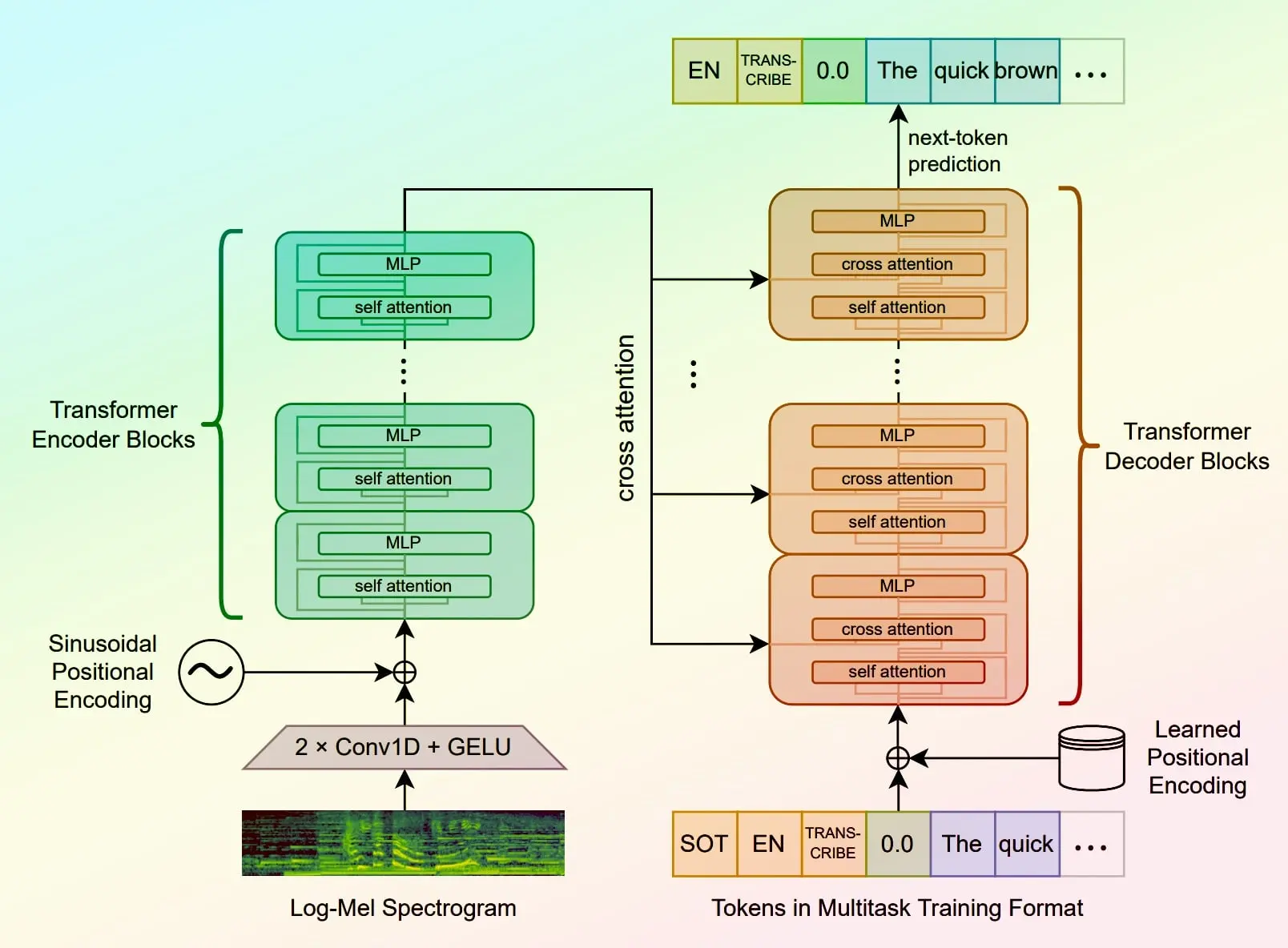
Turbo is not a new architecture. It's the exact same Whisper Large-v3 model with the decoder pruned from 32 layers to 4, then fine-tuned to recover accuracy. The encoder is untouched.
| Large-v3 Turbo | Large-v3 | |
|---|---|---|
| Parameters | 809M | 1,550M |
| Decoder layers | 4 | 32 |
| Languages | 99 | 99 |
| Translation task | Not supported | Supported |
| License | MIT | Apache 2.0 |
The translation task was explicitly excluded from Turbo's training data. The full Large-v3 model supports it, but Whisper Notes ships Turbo only — translation is handled separately via Apple Intelligence.
The Base Model: What Is Whisper Large-v3?
Whisper Large-v3 is OpenAI's flagship open-source speech recognition model, released in November 2023. It has 1.55B parameters, uses a 128 mel-bin spectrogram input, was trained on 5 million hours of audio (1M weakly labeled + 4M pseudo-labeled), and supports 99 languages including Cantonese. On the Hugging Face Open ASR Leaderboard it averages ~7.4% word error rate — the accuracy ceiling that Turbo is measured against throughout this article. For how Large-v3 stacks up against every other on-device model, see our Whisper models comparison.
Speed Benchmark: Whisper Notes on Apple Silicon
In Whisper Notes for Mac, Turbo runs via CoreML on the Neural Engine. Processing 10 minutes of audio:
| Device | Whisper V3 | V3 Turbo | Speedup |
|---|---|---|---|
| iPhone 15 Pro | 425 s | 82 s | 5.2× |
| iPad Pro M2 | 380 s | 71 s | 5.4× |
| MacBook Pro M2 | 316 s | 63 s | 5.0× |
The 5× speedup is specific to Whisper Notes on Apple Silicon, where the smaller decoder benefits from Neural Engine optimization. On GPU with frameworks like faster-whisper, the gap narrows to ~2.7× (see community benchmarks below).
Accuracy: WER Comparison
The Hugging Face Open ASR Leaderboard tests both models on the same English datasets. Turbo's word error rate is within half a point of V3 across every benchmark:
| Dataset | V3 Turbo WER | V3 WER |
|---|---|---|
| LibriSpeech Clean | 2.10% | 2.01% |
| LibriSpeech Other | 4.24% | 3.91% |
| GigaSpeech | 10.14% | 10.02% |
| Earnings22 | 11.63% | 11.29% |
| AMI | 16.13% | 15.95% |
| Mean WER | 7.83% | 7.44% |
V3 is slightly more accurate on every dataset, but the gap is small — 0.39 percentage points on average. For most real-world transcription, you won't hear the difference.
On the YouTube-commons long-form evaluation (one of the largest open-source ASR benchmarks), Turbo scores 13.40% WER vs V3's 13.20% — while running at 129.5× real-time factor vs 55.3×. That's 2.3× faster with nearly identical accuracy on real-world audio.
How Accurate Is Turbo in Korean, Russian, and Other Languages?
The benchmarks above are English. Per OpenAI's model card, Turbo's pruned 4-layer decoder costs slightly more accuracy in non-English languages than in English, with the largest degradation on lower-resource languages. For Russian and most European languages, Turbo stays close to full Large-v3 — and if you're on Whisper Notes, Parakeet V3 covers Russian and 24 other European languages at 10× Whisper's speed.
For Korean, Japanese, Chinese, and Cantonese, a purpose-built model is both faster and better-punctuated: SenseVoice transcribes CJK at 52× real-time. Whisper Notes ships SenseVoice alongside Turbo on both Mac and iOS, so you can pick the right model per language instead of forcing everything through one.
Community Benchmarks: GPU & CPU
Independent benchmarks from the faster-whisper and whisper.cpp communities show consistent results across hardware. Transcribing 13 minutes of audio with faster-whisper on GPU:
| Model | Precision | Time | GPU Memory | WER |
|---|---|---|---|---|
| Large-v3 Turbo | fp16 | 19.2 s | 2,537 MB | 1.92% |
| Large-v3 | fp16 | 52.0 s | 4,521 MB | 2.88% |
| Large-v3 Turbo | int8 | 19.6 s | 1,545 MB | 1.92% |
| Distil-Large-v3 | fp16 | 26.1 s | 2,409 MB | 2.39% |
Source: faster-whisper benchmark on NVIDIA GPU, LibriSpeech clean validation split. Turbo int8 uses only 1.5 GB VRAM — it fits on a 2 GB GPU.
Batched inference on an RTX 3060 Laptop (6 GB VRAM, int8 precision) pushes the advantage further:
| Model | Sequential | Batched (10) | Batched WER |
|---|---|---|---|
| Large-v3 Turbo | 46.1 s | 18.7 s | 7.7% |
| Large-v3 | 230.8 s | 43.0 s | 7.9% |
| Large-v2 | 178.3 s | 43.2 s | 8.8% |
| Medium | 113.3 s | 26.3 s | 8.9% |
Source: NilaierMusic benchmark, Intel i7-12650H + RTX 3060 Laptop 6 GB, French audio, int8 precision.
With batched processing, Turbo achieves the best WER of any model tested (7.7%) while being the fastest. It's the clear sweet spot for production use.
Turbo vs Medium vs Every Whisper Model Size
Before Turbo, Medium was the usual compromise: acceptable accuracy at tolerable speed. Turbo makes that trade-off obsolete — at 809M parameters it is barely larger than Medium (769M), yet delivers large-class accuracy at several times the speed. Here's the full model family side by side:
| Model | Parameters | Disk Size | Relative Speed | Accuracy Tier |
|---|---|---|---|---|
| tiny | 39M | ~75 MB | ~10× | Lowest |
| base | 74M | ~142 MB | ~7× | Low |
| small | 244M | ~466 MB | ~4× | Moderate |
| medium | 769M | ~1.5 GB | ~2× | High |
| large-v3 | 1,550M | ~2.9 GB | 1× (baseline) | Highest |
| large-v3-turbo | 809M | ~1.6 GB | ~8× | Near-highest |
Released September 30, 2024, Turbo is 809M parameters — smaller than you'd expect for large-class accuracy. If you were choosing Medium to save disk space or speed, Turbo now beats it on both accuracy and speed at roughly the same footprint.
Known Limitations (and How Whisper Notes Handles Them)
No built-in translation
Turbo was trained without translation data. It transcribes in the source language only — unlike Large-v3, which supports audio→English translation.
Whisper Notes — Apple Intelligence auto-translates transcripts into your chosen language, giving you bilingual output regardless of which model you use.
More hallucination on noisy audio
Community reports indicate Turbo hallucinates more on very short clips or noisy recordings vs V3. Expected given the reduced decoder (4 layers vs 32).
Whisper Notes — runs Pyannote VAD before transcription, detecting speech segments and stripping silence/noise so the model only processes real voice.
Which Model Should You Use?
| English / European | Parakeet V3 — 10× faster than Whisper, better accuracy |
| Chinese / Japanese / Korean | SenseVoice — purpose-built for CJK, 52× speed |
| Other languages | Whisper Large V3 Turbo — 99 languages, high accuracy, slower |
Whisper Large-v3 Turbo FAQ
What is the difference between Whisper Large-v3 and Large-v3 Turbo?
Large-v3 Turbo keeps the Large-v3 encoder but reduces the decoder from 32 layers to 4. That is why it is much faster while staying close to Large-v3 accuracy for transcription. The trade-off is that Turbo does not support Whisper's built-in translation task.
Does faster-whisper support Large-v3 Turbo?
Yes. faster-whisper supports Large-v3 Turbo through CTranslate2 conversions, and community benchmarks show Turbo is a strong choice when VRAM is limited. In the benchmark above, Turbo int8 used about 1.5 GB VRAM.
Does whisper.cpp support Large-v3 Turbo?
Yes. whisper.cpp can run converted GGML/GGUF versions of Whisper Large-v3 Turbo. If you are building your own local transcription pipeline, Turbo is often easier to fit on consumer hardware than full Large-v3.
Where can I download openai/whisper-large-v3-turbo?
The official model weights are available from OpenAI on Hugging Face. Whisper Notes users do not need to download them manually: the Mac app handles local model setup through the app interface.
Comparing all the local options? Every on-device speech-to-text model — Whisper variants, Parakeet V3, SenseVoice, and Voxtral — is compared side by side on our Whisper models comparison page. New to Whisper itself? Start with the Whisper Transcription Guide — what the model is, every way to run it, and what it costs.
 Download for iOS