
TL;DR — Three On-Device Models Compared
| Parakeet V3 | SenseVoice Small | Whisper Large V3 Turbo | |
|---|---|---|---|
| 5 min English | 2.91s (103×) | 5.8s (52×) | 20.92s (14.3×) |
| 27 min Chinese | No Chinese support | 13.83s (118×) | 2 min 4s (13.1×) |
| Languages | 25 (European) | 5 (zh, en, ja, ko, yue) | 100+ |
| Download | 465 MB | 827 MB | ~1.6 GB |
| Best for | English & European | Chinese, Japanese, Korean, Cantonese | Everything else (100+ languages) |
* Speed benchmarks on Apple M4 Pro, 32 GB. 5-minute English podcast and 27-minute Chinese podcast. Realtime factor = audio duration ÷ processing time (higher = faster). Benchmarks are from the Mac version; SenseVoice is also available on iPhone.
Starting with version 1.5.0 (Direct Download / DMG), Whisper Notes for Mac ships SenseVoice Small as the dedicated engine for Chinese, Japanese, Korean, and Cantonese transcription. It replaces Qwen3-ASR and runs on Apple's GPU via MLX instead of CPU — processing a 27-minute Chinese podcast in 13.83 seconds instead of 3 minutes and 44 seconds.
Why We Replaced Qwen3-ASR
Qwen3-ASR was a solid model. It supported 30 languages plus 22 Chinese dialects, and its Chinese accuracy was near state-of-the-art. But it had a problem that got worse the longer the audio: speed.
Qwen3 used an autoregressive architecture — the same approach as Whisper, processing audio frame by frame and never skipping ahead. On a 27-minute Chinese podcast, it took 224 seconds. Usable, but not the instant-result experience that Parakeet V3 delivers for English.
The deeper issue was our infrastructure. Our Qwen3 integration used sherpa-onnx, a C library with a 2,249-line Swift wrapper that routed everything through CPU cores. The GPU sat idle while your Mac's CPU did all the work.
SenseVoice fixed both problems. Non-autoregressive architecture for speed. Apple MLX for GPU acceleration. The result: a 16.2× speed improvement on the same hardware, with a codebase reduced from 2,249 lines to 288.
The Benchmark
All three models running on the same Apple M4 Pro, same audio files, same conditions. No cloud. No internet. Just silicon.
| Model | 5 min English | 27 min Chinese | Speed (RTFx) |
|---|---|---|---|
| Parakeet V3 | 2.91s | No Chinese support | 103× |
| SenseVoice Small | 5.8s | 13.83s | 52–118× |
| Whisper Large V3 Turbo | 20.92s | 2 min 4s | 13–14× |
| Qwen3-ASR (removed) | — | 224s | 7.2× |
On English, SenseVoice runs at roughly half Parakeet's speed — still extraordinarily fast. On Chinese, Parakeet is not an option at all, and SenseVoice finishes a 27-minute podcast in under 14 seconds. You press transcribe, you wait one breath, and the text is there.
Compare that to Whisper at 2 minutes and 4 seconds, or the old Qwen3 at 3 minutes and 44 seconds. The architecture matters more than the parameter count.
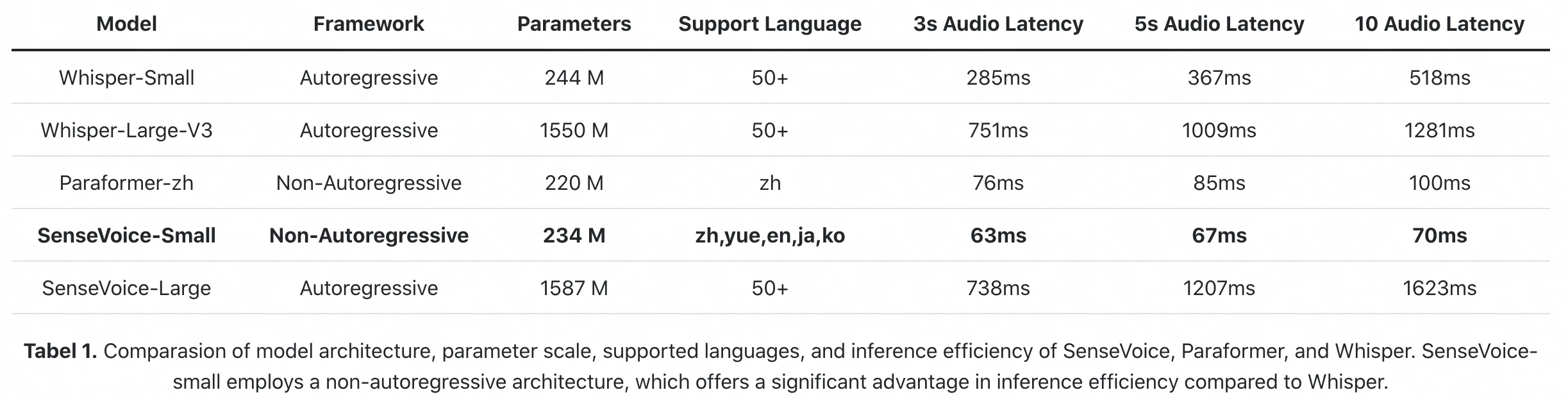
Official inference benchmark from the FunAudioLLM paper: SenseVoice-Small processes 10s of audio in 70ms (A800 GPU). Whisper-Large-V3 takes 1,281ms on the same hardware. Note that this is datacentre-GPU inference latency, not the on-device numbers above.
| Model | Load Time | Download Size |
|---|---|---|
| Parakeet V3 | 0.77s | 465 MB |
| SenseVoice Small | 0.81s | 827 MB |
| Whisper Small | 1.03s | 600 MB |
| Whisper Large V3 Turbo | 3.18s | ~1.6 GB |
* Load time measured on Apple M4 Pro, 32 GB.
SenseVoice loads in under a second. On an 8 GB Mac, it runs comfortably alongside your other applications.
Why SenseVoice Is Faster: Architecture + Runtime
The speed gap between Qwen3-ASR and SenseVoice comes from two independent factors.
Factor 1: Model architecture. Qwen3-ASR is autoregressive — it generates text token by token, each depending on the previous one. SenseVoice uses a non-autoregressive (NAR) encoder that processes the entire audio in parallel. This architectural difference alone makes SenseVoice fundamentally faster, regardless of what hardware you run it on.
Factor 2: Runtime. Our Qwen3-ASR integration used sherpa-onnx, which ran on CPU. SenseVoice runs through Apple MLX, routing computation to the GPU. Could Qwen3 also run on MLX? Yes — but it would still be slower than SenseVoice because the autoregressive bottleneck is in the architecture, not the runtime.
| Qwen3-ASR (old) | SenseVoice (new) | |
|---|---|---|
| Architecture | Autoregressive (token by token) | Non-autoregressive (parallel) |
| Runtime | sherpa-onnx (CPU) | Apple MLX (GPU) |
| 27 min Chinese | 224 seconds | 13.83 seconds |
| Combined speedup | baseline | 16.2× faster |
| Codebase | 168 MB C framework + 2,249 lines Swift | 288 lines Swift Actor |
* Same 27-minute Chinese podcast, Apple M4 Pro. The 16.2× speedup combines both architectural (NAR vs AR) and runtime (GPU vs CPU) improvements.
The code got simpler too. The new SenseVoice implementation is a single 288-line Swift Actor that talks directly to MLX, replacing a 168 MB C framework. Less code, fewer bugs, smaller app.
Five Languages, Done Well
SenseVoice doesn't try to do everything. It handles five languages:
| Language | SenseVoice-Small | Whisper-Large-V3 | Winner |
|---|---|---|---|
| Chinese (zh-CN) | 10.78% CER | 12.55% CER | SenseVoice (-14%) |
| Cantonese (yue) | 7.09% CER | 10.41% CER | SenseVoice (-32%) |
| Japanese (ja) | 11.96% CER | 10.34% CER | Whisper (slight) |
| Korean (ko) | 8.28% CER | 5.59% CER | Whisper |
| English (en) | 14.71% WER | 9.39% WER | Whisper (use Parakeet) |
* CommonVoice benchmark, CER = Character Error Rate, WER = Word Error Rate. Lower is better. Source: FunAudioLLM paper (2024). SenseVoice-Small inference latency: 70ms per 10s audio on an A800 GPU, against 1,281ms for Whisper-Large-V3 on the same hardware.
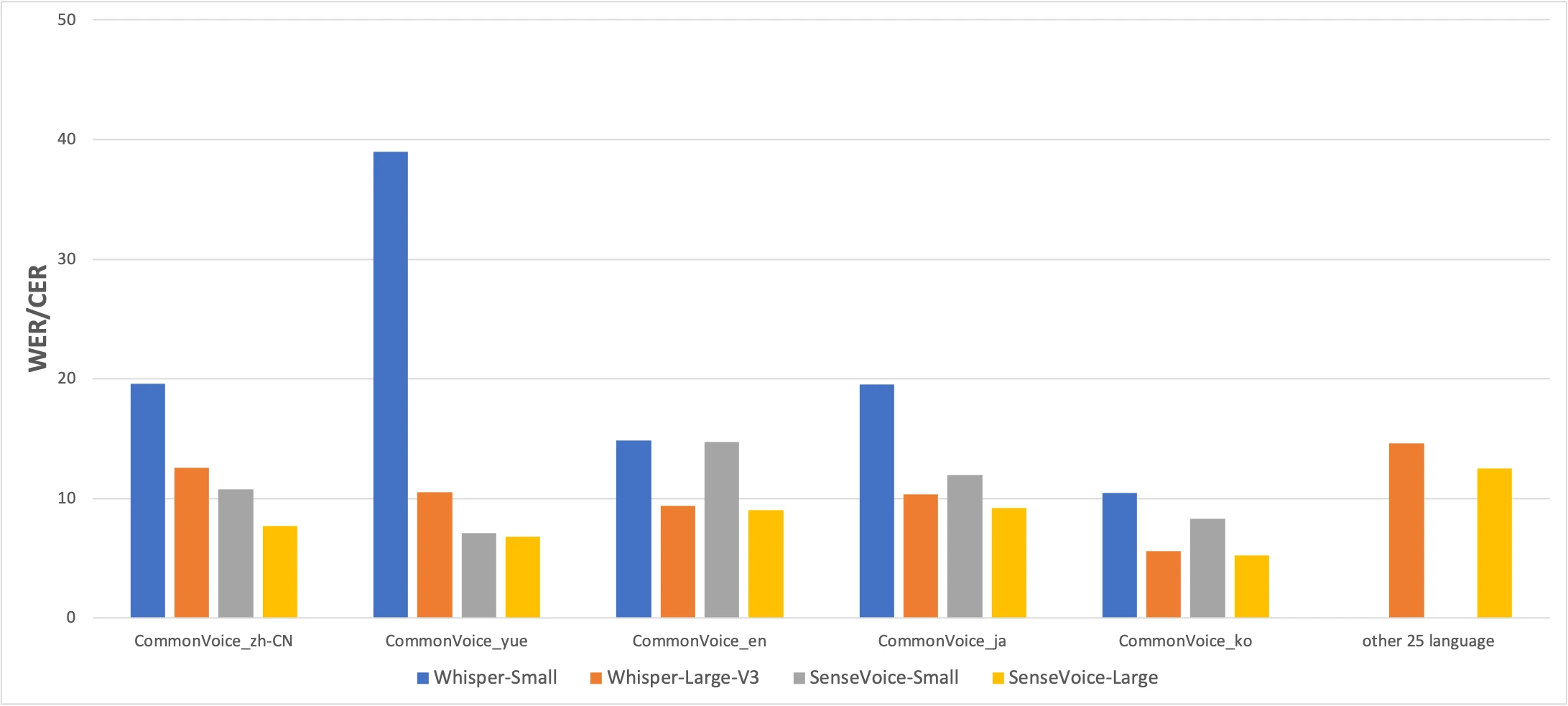
CommonVoice benchmark: SenseVoice-Small (yellow) vs Whisper-Small (blue) vs Whisper-Large-V3 (orange). Lower is better. Source: FunAudioLLM paper
The numbers tell an honest story. SenseVoice beats Whisper on Chinese and Cantonese accuracy by a significant margin, while Whisper is more accurate for Japanese, Korean, and English. But SenseVoice runs at 52× realtime or better on Apple Silicon. For most real-world use, the speed difference matters more than a few percentage points of accuracy.
The Cantonese result is worth highlighting separately. Whisper-Small scores 38.97% CER on Cantonese — nearly unusable. Even Whisper-Large-V3 only manages 10.41%. SenseVoice hits 7.09%. Before SenseVoice, there was no good way to transcribe Cantonese locally on a Mac. If you speak Cantonese, this model exists for you. One update since: on the Mac direct download, Qwen3-ASR 1.7B (Beta) measured far more accurate on Cantonese in our own FLEURS read-speech run — a different set from the CommonVoice figures above, so the two are not directly comparable — while SenseVoice stays the fast option and the only Cantonese engine on iPhone and in the Mac App Store build.
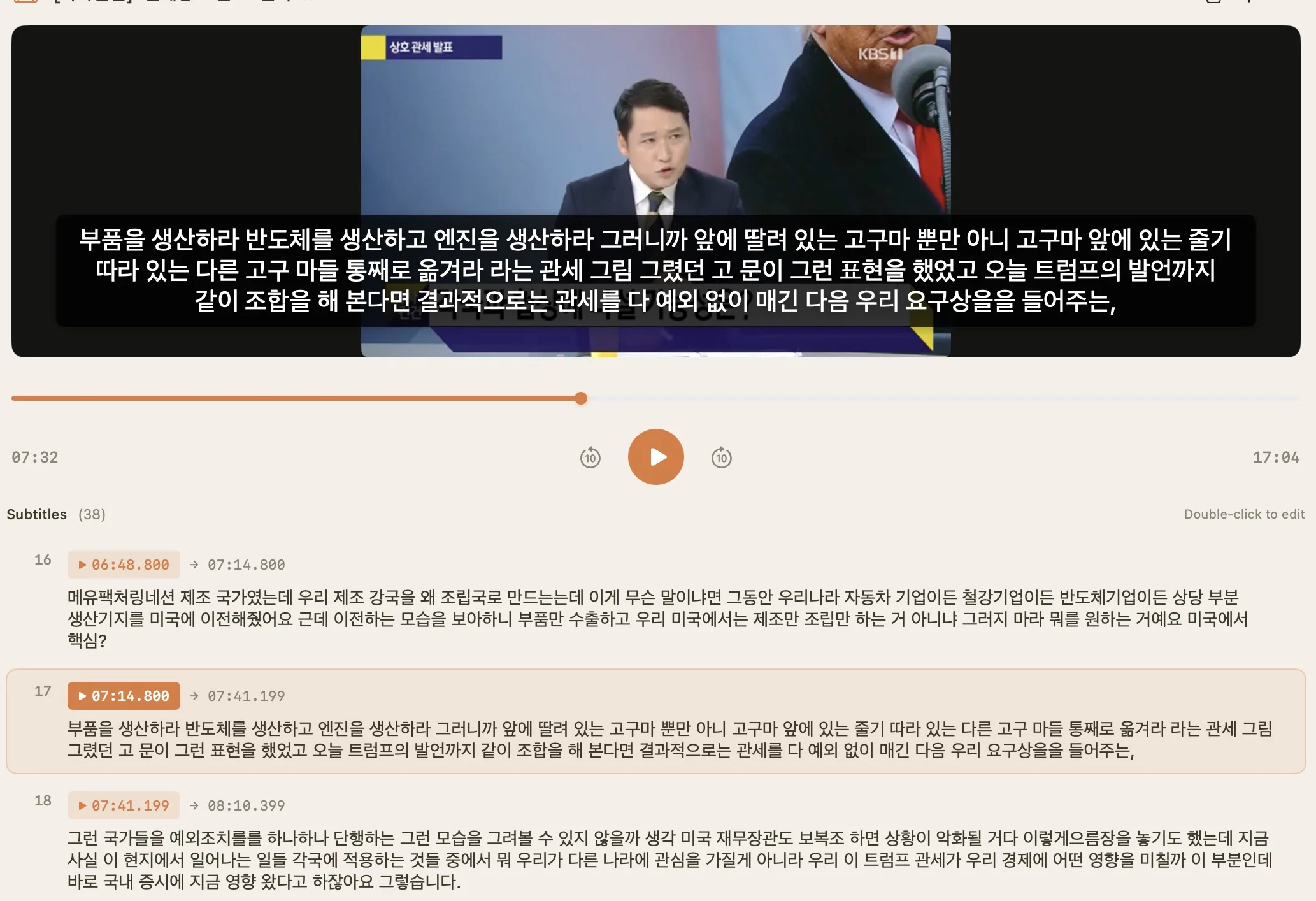
Korean transcription with SenseVoice: video import with timestamped subtitles
Real-World Test: 27-Minute Chinese Podcast
We transcribed a 27-minute episode of Thirteen Invitations (十三邀), a Chinese interview podcast, with both SenseVoice and Whisper Large V3 Turbo on the same M4 Pro. ElevenLabs Scribe (cloud) served as reference. Both on-device models make roughly the same number of errors, but different kinds:
| SenseVoice | Whisper Large V3 | |
|---|---|---|
| Time | 13.83s | 2 min 4s |
| Errors (5 min sample) | ~15–20 | ~12–15 |
| Worst error | 时差→食堂 (timezone→cafeteria) | 西昌→西藏 (Xichang city→Tibet, 4,000 km off) |
| Error pattern | Homophone swaps | Geographic/factual errors |
* Manual comparison against ElevenLabs Scribe (cloud reference, also imperfect). Both on-device models correctly wrote "根深蒂固" where Scribe got it wrong.
Comparable accuracy, and the transcript is there in 13.83 seconds instead of two minutes. For real-world Chinese transcription, SenseVoice gets you a usable transcript before Whisper finishes loading.
When to Use Which Model
Whisper Notes for Mac now ships four speech models in both Mac builds, and the direct download (DMG) adds a fifth from version 1.6.0, Qwen3-ASR 1.7B (Beta). Each of the four below is optimized for a different scenario:
| You need... | Use this model | Why |
|---|---|---|
| English or European languages, maximum speed | Parakeet V3 | 103× realtime, lowest error rate. The default. |
| Chinese, Japanese, Korean, or Cantonese | SenseVoice Small | 52–118× realtime. The only Cantonese engine on iPhone and in the Mac App Store build. |
| Any of 100+ languages (Arabic, Thai, Russian, etc.) | Whisper Large V3 Turbo | Broadest language support. Slower but universal. |
| All 101 languages on an older Mac | Whisper Small | 600 MB, the lightest of the Whisper models, and it still reaches 101 languages. |
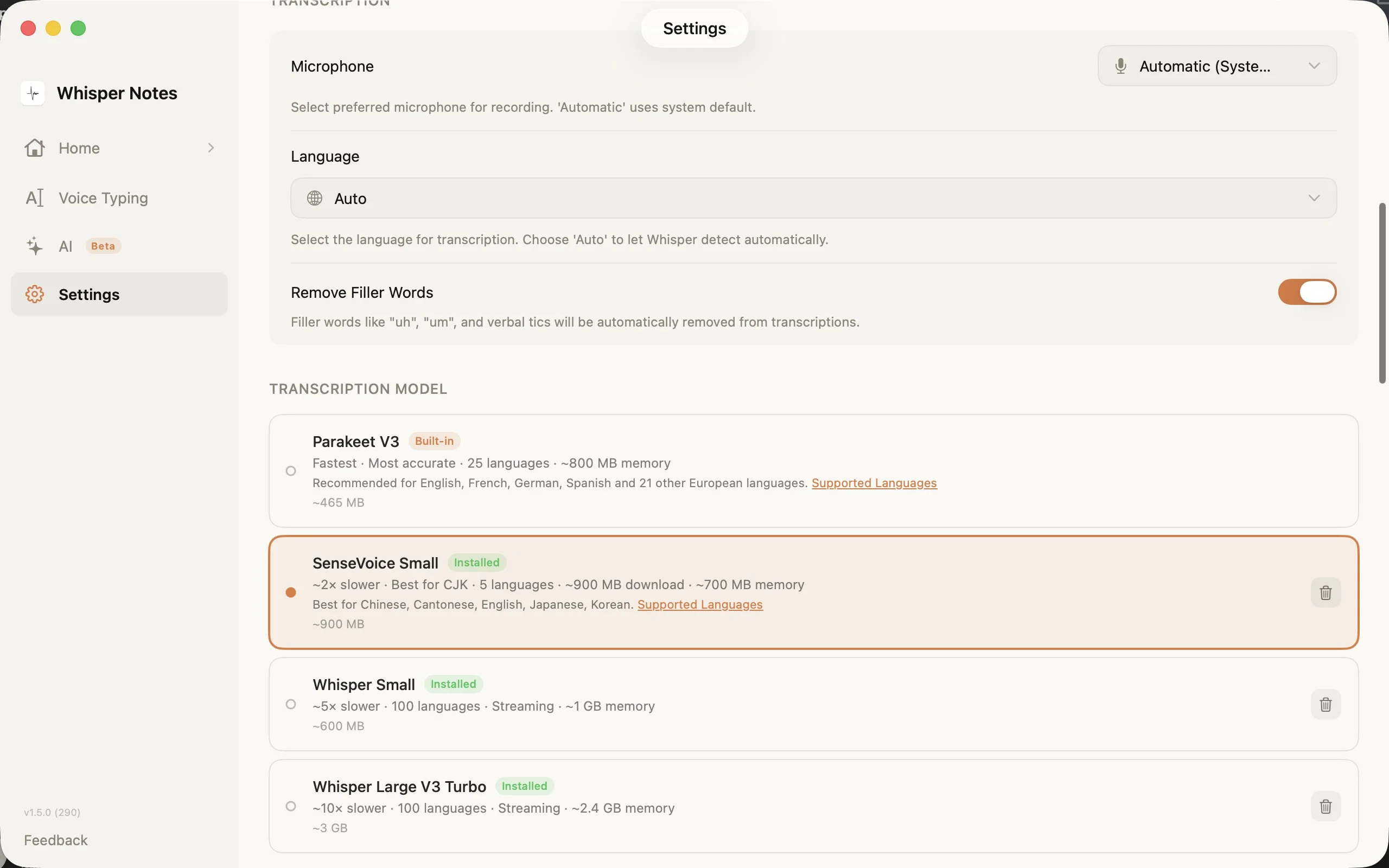
Settings → Transcription Model: choose the right engine for your language
The model picker in Settings shows every model your build offers, with download sizes, language counts, and memory requirements. SenseVoice downloads on first use (~827 MB) and stays on your device.
The Trade-offs
SenseVoice is not a universal model, and the limits are specific:
• Only 5 languages. If you need Thai, Russian, Arabic, Hindi, or another language outside SenseVoice's CJK focus, stick with Whisper.
• Update: SenseVoice originally shipped Mac-only via Apple MLX, but it's now available on iPhone as well — iOS supports the same model lineup as Mac: Parakeet V3, Whisper, and SenseVoice.
• Quiet audio quirk. During very short or very quiet segments, SenseVoice can sometimes fall back to Chinese output regardless of the selected language. Setting the language manually (instead of "Auto") reduces this.
• No streaming. Unlike Whisper's streaming mode, SenseVoice processes the full audio after recording. For long files, it auto-segments at silence points and shows results progressively.
These are architectural constraints, not bugs. A model trained on 5 languages does those 5 languages extremely well. Whisper's 100+ language coverage comes with slower speed and uneven accuracy across languages.
Comparing all the local options? Every on-device speech-to-text model — Whisper variants, Parakeet V3, SenseVoice, and Voxtral — is compared side by side on our Whisper models comparison page. New to Whisper itself? Start with the Whisper Transcription Guide — what the model is, every way to run it, and what it costs.
Frequently Asked Questions
What is the fastest Whisper alternative for Chinese, Japanese, and Korean transcription?
SenseVoice Small is available in Whisper Notes on both Mac and iPhone. In our Mac test on an M4 Pro, it transcribed a 27-minute Chinese podcast in 13.83 seconds (52–118× realtime), while Whisper Large V3 Turbo took over 2 minutes for the same file.
Is SenseVoice better than Whisper for Chinese?
For Chinese and Cantonese, yes. On the CommonVoice benchmark, SenseVoice scores 10.78% CER on Chinese vs Whisper-Large-V3's 12.55%, and on our M4 Pro it ran a 27-minute podcast in 13.83 seconds against Whisper's 2 minutes 4 seconds. Whisper remains slightly more accurate for Japanese and Korean, so if those are your main languages, either engine is a reasonable pick.
Can I transcribe Cantonese locally on a Mac?
Yes. SenseVoice scores 7.09% CER on Cantonese, compared to 10.41% for Whisper-Large-V3 and a nearly unusable 38.97% for Whisper-Small. Before SenseVoice, there was no good way to transcribe Cantonese locally on a Mac.
Does SenseVoice work on iPhone?
Yes. Whisper Notes on iPhone supports the same model lineup as Mac — Parakeet V3, Whisper, and SenseVoice — so you can transcribe Chinese, Japanese, Korean, and Cantonese locally on your iPhone too.
Try It
SenseVoice is available in Whisper Notes for Mac v1.5.0 (Direct Download / DMG) and later, and in the current iPhone app. On Mac, download it from Settings → Transcription Model → SenseVoice Small (~827 MB). The Mac version requires Apple Silicon (M1 or later).
If you're on Parakeet V3 and dictate mostly in English, there's no need to switch. SenseVoice is for when you need Chinese, Japanese, Korean, or Cantonese — and you want it fast.
 Download for Mac
Full changelog: whispernotes.app/changelog
Questions or feedback: mac@whispernotes.app